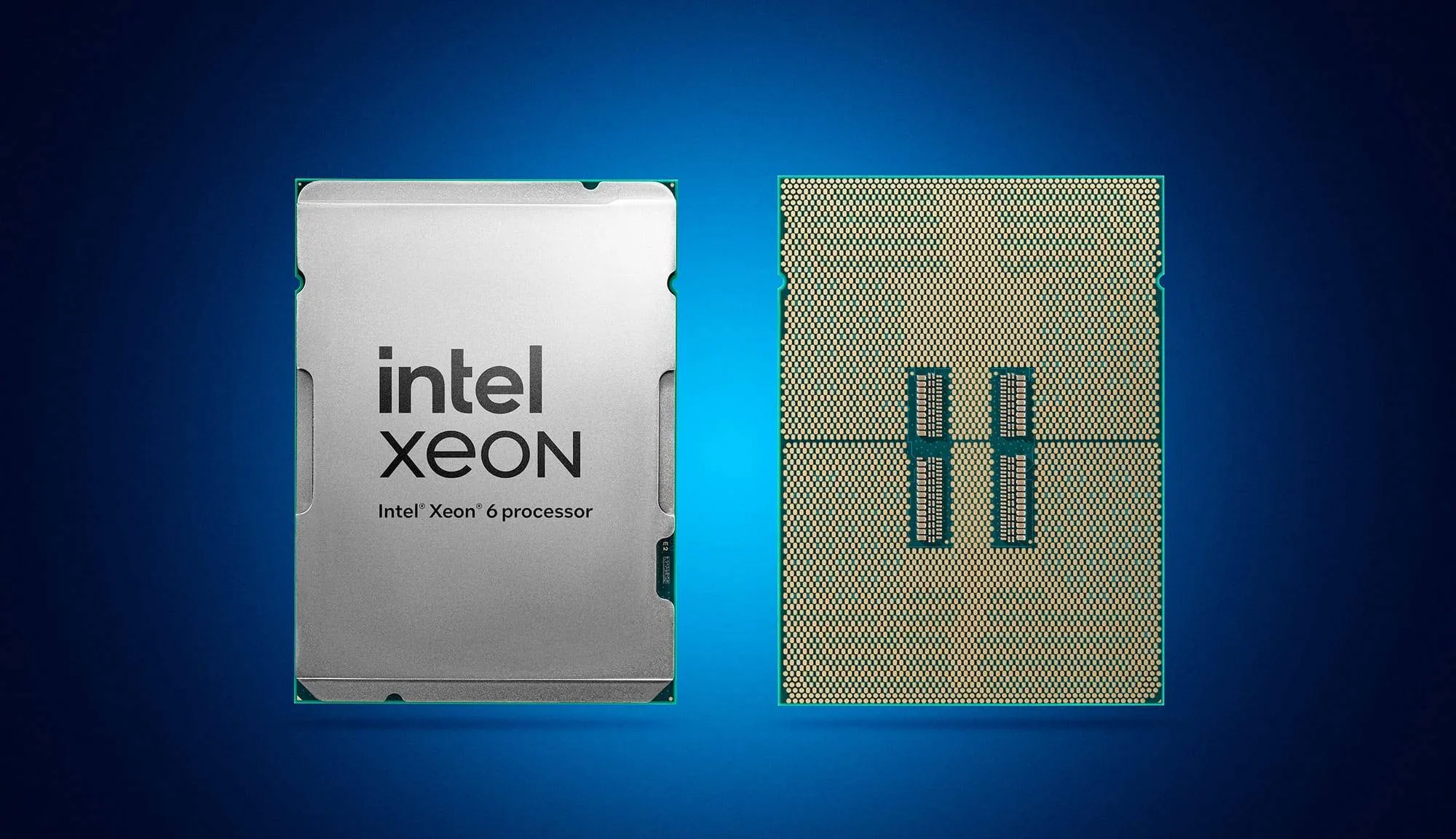
When ordinary server hardware is no longer enough, the conversation changes completely.
A modern high-end server is not simply a computer with a powerful processor. It is a carefully balanced system involving enormous CPU compute capacity, high-bandwidth memory, enterprise NVMe storage, PCIe connectivity, high-speed networking, accelerators, virtualization, redundancy, and serious power and cooling infrastructure.
For extreme workloads in 2026, Intel’s Xeon 6 platform with P-cores represents the company’s highest-performance general-purpose server CPU family.
At the top of the range is the Intel Xeon 6980P, offering 128 cores and 256 threads, 504 MB of cache, 12 memory channels, and a 500 W TDP. The Xeon 6900 P-core family is specifically positioned for demanding cloud, AI and HPC environments.
But the most expensive processor is not automatically the best processor for every workload.
A database, virtualization host, AI server, HPC workstation, web-hosting machine, software build server, and storage server can have completely different requirements.
The right question is therefore not:
“What is the fastest Xeon?”
It is:
“Which Xeon architecture and server configuration can deliver the best performance for my particular workload?”
Intel Xeon 6: The High-End Server Generation
Intel Xeon 6 is a major transition in Intel’s server portfolio.
The family includes both Performance-core (P-core) and Efficiency-core (E-core) designs.
The distinction is important.
P-core Xeon 6 processors are designed around high-performance computing, AI, HPC and demanding general-purpose workloads.
E-core Xeon 6 processors prioritize high core density and performance per watt for highly parallel, scalable workloads.
Intel positions the Xeon 6900 P-core family at the top end for demanding cloud, AI and HPC environments, while the 6700 series targets a broader range of data-center and telecommunications workloads.
For an extreme-performance server, the P-core models are the most interesting starting point.
The Intel Xeon 6980P: The Flagship
At the top of the P-core range is the Intel Xeon 6980P.
Its specifications include:
- 128 cores
- 256 threads
- 2.0 GHz base frequency
- 3.9 GHz maximum turbo
- 3.2 GHz all-core turbo
- 504 MB cache
- 500 W TDP
- Up to 12 memory channels
- DDR5 and MRDIMM support
- Up to 8,800 MT/s with supported MRDIMMs
- Up to 96 PCIe 5.0 lanes
- Two-socket scalability
Intel’s current specifications confirm the 128-core/256-thread configuration, 504 MB cache and 500 W TDP.
This is not a conventional desktop-style CPU.
It is designed for servers where enormous sustained compute capacity is more important than minimizing power consumption.
A dual-socket system can theoretically provide:
256 physical cores
and:
512 threads
That is an extraordinary amount of CPU capacity in a single server.
Xeon 6979P: 120-Core Extreme Compute
The Xeon 6979P sits immediately below the flagship.
It provides:
- 120 cores
- 240 threads
- 2.1 GHz base frequency
- 3.9 GHz maximum turbo
- 3.2 GHz all-core turbo
- 504 MB cache
- 500 W TDP
The difference between 120 and 128 cores may appear small, but at this level the economics of the complete server become important.
If the 6979P platform can be obtained at substantially lower cost, it can make sense to allocate the difference toward:
- More memory
- Faster storage
- Networking
- GPUs
- Redundant power
- Additional servers
Extreme computing is rarely about the CPU alone.
Xeon 6972P: 96 Cores With Higher All-Core Frequency
The Xeon 6972P is one of the particularly interesting processors in the lineup.
It has:
- 96 cores
- 192 threads
- 2.4 GHz base frequency
- 3.5 GHz all-core turbo
- 3.9 GHz maximum turbo
- 480 MB cache
- 500 W TDP
This combination is important.
The flagship 6980P has substantially more cores, but the 6972P has a higher base frequency and all-core turbo frequency.
That makes it potentially attractive for workloads that benefit from both high parallelism and strong per-core performance.
Xeon 6960P: High Frequency Across 72 Cores
The Xeon 6960P takes the concept even further.
It provides:
- 72 cores
- 144 threads
- 2.7 GHz base
- 3.8 GHz all-core turbo
- 3.9 GHz maximum turbo
- 432 MB cache
- 500 W TDP
The processor is therefore not simply about maximizing core count.
It provides a very high level of sustained frequency across a large number of P-cores.
For workloads where per-core performance matters alongside parallelism, this can be a very interesting configuration.
Intel also provides configurable performance profiles for this processor, including configurations with fewer active cores and higher base frequency.
Xeon 6952P: 96 Cores at 400 W
The Xeon 6952P offers:
- 96 cores
- 192 threads
- 2.1 GHz base
- 3.2 GHz all-core turbo
- 3.9 GHz maximum turbo
- 480 MB cache
- 400 W TDP
For organizations building large fleets of servers, the lower TDP can be significant.
At hyperscale, hundreds or thousands of watts saved per server become substantial operational savings.
The 6700 P-Core Family
Not every high-end server needs a 6900-series processor.
The Xeon 6700 P-core family provides extremely high performance while occupying a different position in the product range.
For example, the Xeon 6787P provides up to 86 P-cores and is part of Intel’s high-performance 6700 family.
Intel describes the 6700 P-core series as designed for broad data-center and telecommunications workloads, while the 6900 series targets maximum performance for demanding cloud, AI and HPC environments.
This makes the 6700 family particularly interesting for organizations that need very powerful servers but do not necessarily need the maximum possible CPU density.
Xeon 6980P vs 6979P vs 6972P vs 6960P
| Processor | Cores | Threads | Base | All-Core Turbo | Max Turbo | Cache | TDP |
|---|---|---|---|---|---|---|---|
| Xeon 6980P | 128 | 256 | 2.0 GHz | 3.2 GHz | 3.9 GHz | 504 MB | 500 W |
| Xeon 6979P | 120 | 240 | 2.1 GHz | 3.2 GHz | 3.9 GHz | 504 MB | 500 W |
| Xeon 6972P | 96 | 192 | 2.4 GHz | 3.5 GHz | 3.9 GHz | 480 MB | 500 W |
| Xeon 6960P | 72 | 144 | 2.7 GHz | 3.8 GHz | 3.9 GHz | 432 MB | 500 W |
| Xeon 6952P | 96 | 192 | 2.1 GHz | 3.2 GHz | 3.9 GHz | 480 MB | 400 W |
Specifications from Intel’s current product comparison and individual product documentation.
More Cores Does Not Always Mean More Performance
This is one of the most important principles when selecting a high-end server.
A 128-core processor is not automatically faster than a 72-core processor for every application.
Consider two workloads.
Workload A
A highly parallel scientific simulation can use hundreds of threads.
In this situation:
128 cores > 72 cores
may be a very reasonable expectation.
Workload B
An application depends heavily on a smaller number of highly optimized threads.
The higher-frequency 6960P could potentially be more appropriate.
This is why benchmarking the actual application is more valuable than comparing core counts alone.
Extreme HPC Workloads
High-performance computing is one of the areas where Xeon 6900 P-core processors are particularly relevant.
HPC applications can include:
- Scientific simulations
- Computational fluid dynamics
- Engineering simulations
- Weather modeling
- Financial modeling
- Molecular analysis
- Research workloads
- Large-scale numerical computation
Intel’s Xeon 6 P-core platform supports features particularly relevant to HPC, including high memory bandwidth, PCIe 5.0, CXL, AVX-512 and large cache capacities.
The flagship 6900 processors provide up to 12 memory channels and support high-speed MRDIMMs.
That matters because some HPC applications are limited not by CPU execution resources but by how quickly data can be supplied to those cores.
Memory Is Just as Important as the CPU
One of the biggest mistakes when building an extreme server is spending almost the entire budget on CPUs.
A server with hundreds of CPU cores needs enormous memory bandwidth.
The Xeon 6900 P-core platform provides:
12 memory channels per socket
and supports DDR5 and MRDIMM technologies.
Intel lists MRDIMM speeds of up to 8,800 MT/s for the Xeon 6900 P-core family.
A dual-socket system therefore has:
24 memory channels
available across the two processors.
This is one reason dual-socket Xeon systems can be extremely powerful for memory-intensive workloads.
MRDIMM and Memory Bandwidth
Modern CPUs can execute enormous numbers of instructions per second.
But the processor can only work as fast as the data arrives.
For memory-bound applications, memory bandwidth can therefore become a critical bottleneck.
Intel specifically highlights MRDIMM technology for Xeon 6 P-core systems, with up to 8,800 MT/s supported in the Xeon 6900 family.
For workloads such as HPC, analytics and some AI-related workloads, this can be extremely important.
AI Workloads
AI is another area where the Xeon 6 P-core platform becomes interesting.
The CPUs include Intel AMX and other acceleration technologies.
Intel describes Xeon 6 P-core processors as suitable for AI inference and as host CPUs for accelerator-based AI systems.
However, an important distinction needs to be made.
A huge Xeon is not necessarily the optimal solution for every AI workload.
For large-scale AI training, GPUs or dedicated accelerators generally play the primary compute role.
The Xeon CPU can instead act as the powerful host platform responsible for:
- Data preprocessing
- Storage management
- Networking
- Orchestration
- Virtualization
- CPU inference
- Feeding accelerator pipelines
This makes a high-end Xeon server particularly interesting as an AI infrastructure platform.
Intel AMX
Intel Advanced Matrix Extensions, or AMX, are particularly relevant to AI workloads.
They accelerate certain matrix operations used heavily in machine learning.
This means that CPU-based AI inference can benefit from dedicated hardware acceleration rather than relying solely on conventional CPU instructions.
Intel states that Xeon 6 P-core processors provide AMX support for INT8, BF16 and FP16 workloads.
For smaller AI models and inference workloads, this can make CPU-based deployments considerably more interesting.
Databases
Large databases present a completely different challenge.
The biggest CPU is not necessarily the best database server.
Database performance depends on:
- CPU performance
- Memory capacity
- Memory bandwidth
- NUMA architecture
- Storage latency
- Storage throughput
- Network performance
- Database engine
- Query architecture
- Indexing
- Concurrency
For very large databases, a processor such as the 6972P or 6960P may be interesting because of the combination of high core counts and high frequencies.
But database benchmarking should always be performed using the actual workload.
Virtualization
High-end Xeon processors are also extremely attractive for virtualization.
Consider a dual-socket server with two 6980P processors.
In theory, the machine has:
256 physical cores
and:
512 threads
That provides enormous capacity for virtual machines.
A single server could potentially host large numbers of:
- Linux VMs
- Windows VMs
- Containers
- Development environments
- Database instances
- Web servers
- Application servers
The limiting factors may quickly shift away from CPU.
Memory could become the first bottleneck.
Then storage.
Then networking.
This is why an extreme virtualization server needs to be designed as a complete system.
Proxmox and High-End Xeon
For organizations using Proxmox VE, a dual-socket Xeon 6 server could provide an extremely powerful virtualization platform.
A possible architecture could include:
2 × Xeon 6980P
1–2 TB ECC memory
Multiple enterprise NVMe SSDs
25/50/100 GbE networking
ZFS or enterprise storage
Redundant power supplies
High-performance cooling
This could become an extremely dense virtualization node.
The actual configuration should be determined by the VM workload and NUMA topology.
Web Hosting at Extreme Scale
A high-end Xeon server can also be used for very large hosting environments.
Imagine hosting:
- Thousands of websites
- Large WordPress installations
- Databases
- PHP workers
- Redis
- MariaDB
- Nginx/Apache
- Containers
- Monitoring
- Backup systems
Here, raw CPU power is only part of the equation.
A hosting server also needs:
Fast NVMe
Large RAM capacity
High network bandwidth
Excellent I/O performance
Reliable storage
Efficient virtualization
Strong monitoring
A 128-core CPU paired with slow storage is a badly balanced server.
WordPress and Massive Web Hosting
For a large WordPress hosting platform, high CPU density can be useful because PHP workloads can be highly concurrent.
Imagine hundreds or thousands of WordPress sites receiving requests simultaneously.
The CPU must process:
- PHP
- Database queries
- Object caching
- Image processing
- Cron tasks
- Search indexing
- Background jobs
The 6980P’s enormous core count can provide substantial parallel processing capacity.
But database and storage performance remain critical.
A better architecture may therefore be:
Xeon 6
Large ECC RAM
Enterprise NVMe
Redis
MariaDB/MySQL optimization
CDN
Load balancing
rather than simply buying the largest CPU available.
Software Compilation
Large software projects can also benefit from high core counts.
Compilation workloads often parallelize effectively.
A high-end Xeon can therefore be useful for:
- Linux kernel compilation
- Large C/C++ projects
- Rust projects
- Container image builds
- CI/CD infrastructure
- Software testing
A 128-core machine can run enormous numbers of compilation tasks simultaneously.
For organizations running continuous integration at scale, this can significantly reduce build times.
Video Encoding and Rendering
Media workloads are often highly parallel.
CPU-based encoding can therefore make good use of large core counts.
However, modern video production can also benefit significantly from dedicated hardware encoders and GPUs.
The best architecture depends on the codecs and applications involved.
For CPU-heavy rendering or encoding, Xeon 6900 P-core systems are compelling.
For mixed CPU/GPU workloads, a Xeon may instead serve as the host platform around one or more accelerators.
Networking
Extreme servers also need extreme networking.
A 100 GbE or faster network interface can make sense in certain HPC, storage, AI and virtualization environments.
Intel’s Xeon 6900 platform provides up to 96 PCIe 5.0 lanes, providing substantial I/O connectivity for networking, storage and accelerators.
This is important because modern servers can easily become I/O constrained.
You might have:
128 CPU cores
but only:
10 GbE networking
and a small number of SSDs.
The processor would spend significant time waiting for data.
PCIe 5.0 and CXL
The Xeon 6 P-core platform supports PCIe 5.0 and CXL.
These technologies are important for expanding the server beyond the CPU itself.
PCIe provides connectivity for:
- GPUs
- NVMe storage
- Network adapters
- RAID controllers
- Other accelerators
CXL opens additional possibilities around memory and accelerator architectures.
Intel lists up to 96 PCIe 5.0 lanes and up to 64 CXL 2.0 lanes for the Xeon 6900 P-core family.
The Dual-Socket Extreme Server
For truly extreme CPU workloads, a dual-socket configuration is one of the most powerful options.
Consider:
CPU
2 × Xeon 6980P
CPU capacity
256 cores
512 threads
Memory
24 memory channels across the system
Storage
Multiple enterprise NVMe drives
Network
100 GbE
GPU
Optional accelerators
Virtualization
KVM / Proxmox / VMware depending on requirements
This is no longer a conventional server.
It is effectively a small compute node.
NUMA Becomes Important
Dual-socket systems introduce NUMA.
NUMA means Non-Uniform Memory Access.
Each CPU has its own local memory.
A CPU can access memory connected to the other CPU, but the performance characteristics differ.
For highly optimized workloads, understanding NUMA can be critical.
Applications that are NUMA-aware can take advantage of local memory and CPU locality.
Poorly configured workloads can suffer unnecessary latency.
This is one reason that simply adding a second CPU does not always produce a perfect 2× performance increase.
Power Consumption
This is perhaps the biggest practical issue with extreme Xeon servers.
The 6980P has a 500 W TDP.
That is for one processor.
A dual-socket machine therefore has:
1,000 W of CPU TDP alone.
Then add:
- Memory
- Motherboard
- NVMe
- NICs
- GPUs
- Fans
- Controllers
- Power-supply losses
A fully loaded machine can easily require a very substantial power and cooling infrastructure.
This is why high-end Xeon servers belong in serious server rooms or data centers rather than ordinary offices.
Cooling Requirements
A 500 W CPU requires serious cooling.
At this performance level, the chassis needs to be designed around the processors.
Potential solutions include:
- High-pressure server fans
- Large heatsinks
- Advanced air cooling
- Liquid cooling
- Specialized rack systems
The cooling design must also account for memory, VRMs, storage and accelerator cards.
A powerful CPU is useless if thermal limits cause it to throttle.
Storage for Extreme Servers
The ideal storage configuration depends on the workload.
For databases:
Enterprise NVMe + redundancy
For virtualization:
High-IOPS NVMe
For HPC:
High-throughput storage
For media:
Large high-bandwidth storage
For hosting:
Fast random I/O + caching
The key principle is simple:
Do not pair an extreme CPU with consumer-grade storage and expect the system to perform like an extreme server.
Enterprise NVMe
A serious server should generally use enterprise-class storage for demanding workloads.
Important characteristics include:
- Endurance
- Consistent latency
- Power-loss protection
- High IOPS
- Sustained throughput
- Reliability
- Monitoring
Multiple NVMe drives can be configured according to the required storage architecture.
High-End Networking
The network can also become the bottleneck.
For virtualization, storage, AI clusters and HPC, consider:
- 25 GbE
- 50 GbE
- 100 GbE
- Higher-speed networking where justified
The exact choice depends on the environment.
A single web server may not need 100 GbE.
A compute node in an HPC cluster might.
Security and Reliability
High-end Xeon platforms also include enterprise security capabilities.
Intel lists technologies such as:
- Intel TDX
- Intel Total Memory Encryption
- Platform Firmware Resilience
- Intel Secure Key
- Virtualization Technology
- VT-d
on Xeon 6 P-core processors.
These features can be particularly important for cloud providers, virtualization platforms and organizations processing sensitive workloads.
The Importance of Accelerators
A modern extreme server does not necessarily need to be CPU-only.
A powerful Xeon can act as the central host around specialized accelerators.
Depending on the workload, these can include:
- GPUs
- AI accelerators
- FPGA devices
- Network accelerators
- Storage accelerators
This is particularly important for AI.
The CPU handles orchestration and general-purpose computation.
The accelerator handles specialized parallel computation.
A High-End AI Server
A hypothetical extreme AI server might therefore look like:
2 × Xeon 6980P
1–2 TB ECC memory
Multiple enterprise NVMe drives
100 GbE networking
Several high-end GPUs
High-capacity redundant power
Advanced cooling
The Xeon processors provide enormous CPU capacity for:
- Data preprocessing
- Model serving
- Networking
- Storage
- Virtualization
- Scheduling
while the GPUs perform the most demanding AI computations.
The Best Xeon Depends on the Workload
There is no universal winner.
Maximum CPU throughput
Xeon 6980P
Extreme parallel workloads
Xeon 6980P / 6979P
High core count plus stronger all-core frequency
Xeon 6972P
High-frequency multi-core computing
Xeon 6960P
High core count with lower TDP
Xeon 6952P
Very powerful but somewhat broader server deployment
Xeon 6700 P-core family
Intel itself separates the Xeon 6900 and 6700 families according to the intended workload class, with the 6900 series aimed at maximum performance and the 6700 series at a broader range of data-center workloads.
A Practical Extreme Server Configuration
For a genuinely extreme general-purpose server, one possible configuration would be:
CPU
2 × Intel Xeon 6980P
CPU capacity
256 cores / 512 threads
RAM
1–2 TB ECC DDR5/MRDIMM
The exact amount should be determined by the workload.
Storage
4–8 enterprise NVMe SSDs
Configured according to the required redundancy and performance model.
Network
100 GbE
GPU
Optional, depending on AI or accelerated workloads.
Operating system
Linux
Virtualization
Proxmox VE / KVM / another enterprise hypervisor
Storage software
ZFS, hardware RAID, software-defined storage, or another architecture depending on requirements.
Power
Redundant high-capacity PSUs.
Cooling
High-performance server cooling designed specifically for the CPU TDP.
But Is the 6980P Always the Best Choice?
No.
This is perhaps the most important conclusion.
The 6980P is the flagship in terms of core count, but a complete server is a system.
Suppose you have €50,000 available.
You could spend most of it on CPUs.
Or you could build a balanced system with:
- Slightly less CPU
- Much more RAM
- Faster storage
- Better networking
- GPUs
- Redundancy
The second machine could be considerably more useful for some workloads.
The correct design depends on the bottleneck.
CPU-Bound Workload
If the CPU is constantly at 100% and all cores scale efficiently:
Buy more cores.
Memory-Bound Workload
If CPU utilization is relatively low but memory bandwidth is saturated:
Buy faster/wider memory.
Storage-Bound Workload
If the CPU is waiting for storage:
Buy faster NVMe/storage architecture.
Network-Bound Workload
If the network is saturated:
Upgrade networking.
GPU-Bound Workload
If AI or rendering workloads are waiting for GPU computation:
Invest in accelerators rather than additional CPU cores.
This is the fundamental principle of high-performance server design.
Final Ranking for Extreme Intel Xeon Servers in 2026
For someone specifically asking for the highest-end Intel Xeon options, the shortlist is straightforward.
1. Intel Xeon 6980P
128 cores / 256 threads
504 MB cache
500 W
The flagship choice for maximum CPU parallelism.
2. Intel Xeon 6979P
120 cores / 240 threads
504 MB cache
500 W
Extremely close to the flagship in core count.
3. Intel Xeon 6972P
96 cores / 192 threads
3.5 GHz all-core turbo
480 MB cache
500 W
An interesting combination of high core count and higher sustained frequency.
4. Intel Xeon 6960P
72 cores / 144 threads
3.8 GHz all-core turbo
432 MB cache
500 W
Particularly interesting for workloads where high sustained frequency matters.
5. Intel Xeon 6952P
96 cores / 192 threads
480 MB cache
400 W
A lower-TDP alternative within the 6900 P-core family.
6. Intel Xeon 6700 P-Core Family
A strong alternative when the absolute maximum 6900-series configuration is unnecessary.
Intel positions the 6700 P-core family for a broad range of data-center and telco workloads.
Conclusion
The high-end Intel server market in 2026 is no longer about simply finding a CPU with the highest clock speed.
Modern Xeon systems are designed around massive parallelism, memory bandwidth, AI acceleration, high-speed I/O, virtualization, security and scalability.
At the top of the range, the Xeon 6980P provides 128 P-cores and 256 threads, while the rest of the 6900 P-core family provides several different combinations of core count, frequency and power characteristics.
For extreme HPC workloads, massive virtualization, high-density hosting and CPU-intensive computation, these processors can form the foundation of extraordinarily powerful servers.
But the processor is only one part of the equation.
A truly high-performance 2026 server should be designed as a balanced system:
Xeon CPU
High-bandwidth ECC memory
Enterprise NVMe
PCIe 5.0
High-speed networking
Optional GPUs/accelerators
Serious cooling
Reliable power
Correct software architecture
The ultimate machine is therefore not necessarily the server with the most expensive CPU.
It is the server in which every major component is capable of keeping the other components busy.
For the most demanding CPU workloads, the Xeon 6980P represents the extreme end of Intel’s P-core server portfolio. For workloads where frequency, power efficiency, memory, storage or accelerators matter more than absolute core count, processors such as the 6972P, 6960P and 6952P can lead to a more balanced design.
And that is the real story of high-performance servers in 2026: performance is no longer just about the processor—it is about the architecture of the entire machine.