The Internet has never been a finished technology.
From the earliest static websites to today’s social networks, cloud applications, artificial intelligence platforms, blockchain networks, decentralized applications, and immersive digital environments, the Web has continuously evolved.
What began primarily as a way to publish and consume information became a global communication platform. Then it became a platform where billions of people could create content, build businesses, communicate, trade, collaborate, and develop communities.
This evolution is often described through the terms Web 1.0, Web 2.0, and Web 3.0.
Web 1.0 was largely the read-only Web.
Web 2.0 transformed the Internet into a read-write environment dominated by interactive platforms, social media, user-generated content, cloud services, marketplaces, and online communities.
Web 3.0 introduces another possible direction: a Web in which users can have greater control over digital identities, assets, payments, and data through technologies such as blockchain, decentralized identifiers, smart contracts, distributed networks, and cryptographic credentials.
The transition is not happening overnight, and Web 3.0 should not be understood as a simple replacement for Web 2.0. In practice, the technologies overlap. Many future Internet services will probably combine conventional Web technologies with decentralized systems, artificial intelligence, cryptography, distributed storage, and other emerging technologies.
The most interesting question, therefore, is not simply “What is Web 3.0?”
The more important question is:
What will the Internet look like when Web 2.0 technologies and Web 3.0 technologies increasingly converge?
What Is Web 2.0?
Web 2.0 is the interactive Internet most people use every day.
Unlike the early Web, where websites were primarily collections of static pages, Web 2.0 allows users to participate.
People can create accounts, publish articles, upload videos, comment on content, communicate with other users, create communities, sell products, collaborate on documents, and use sophisticated applications directly from a browser.
Examples of Web 2.0 include:
- Social networks
- Blogs
- Online forums
- Video platforms
- Cloud applications
- Online marketplaces
- SaaS applications
- Collaborative platforms
- Wikis
- Web-based publishing platforms
- Online communities
- User-generated content platforms
The defining characteristic of Web 2.0 is participation.
The user is no longer simply consuming information.
The user is creating it.
The Rise of User-Generated Content
One of the biggest transformations introduced by Web 2.0 was the explosion of user-generated content.
Before Web 2.0, publishing on the Internet generally required technical knowledge, access to hosting, and some understanding of HTML or web development.
Web 2.0 dramatically lowered that barrier.
A person could create a blog, upload a photograph, publish a video, write a review, participate in a discussion, or build a social media profile without understanding how servers or databases worked.
This created an enormous expansion of the Internet’s content ecosystem.
Millions of people became publishers.
Businesses became publishers.
Individual creators became publishers.
Communities became publishers.
This development also created entirely new industries around content creation, advertising, influencer marketing, affiliate marketing, SEO, online publishing, and creator economies.
Web 2.0 and the Platform Economy
Web 2.0 also produced the platform economy.
Instead of every website operating independently, enormous companies began creating platforms that connected millions or billions of users.
A platform could provide:
- User accounts
- Hosting
- Content distribution
- Search
- Messaging
- Payments
- Advertising
- Analytics
- Recommendations
- Social connections
- Developer APIs
This model was extremely powerful because network effects made large platforms increasingly valuable.
The more users a platform acquired, the more useful it became.
The more useful it became, the more users wanted to join.
This created a powerful feedback loop.
However, Web 2.0 also introduced a significant structural characteristic: centralization.
A relatively small number of companies can control enormous amounts of infrastructure, data, distribution, advertising, and user attention.
That centralization is one of the reasons Web 3.0 emerged as a technological and philosophical alternative.
What Is Web 3.0?
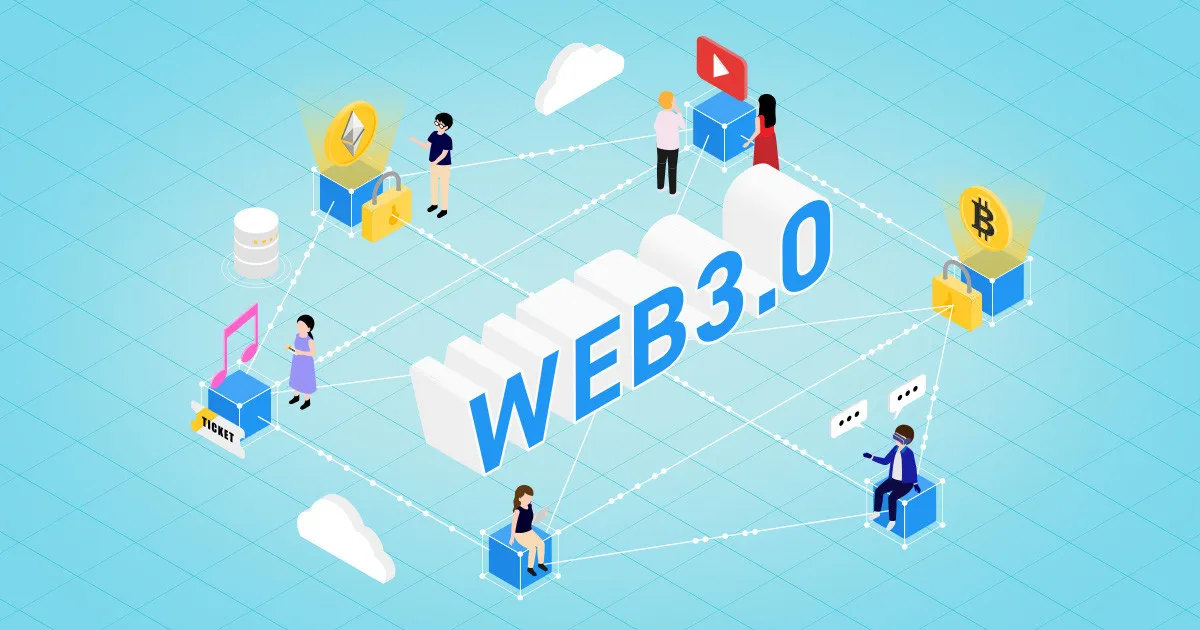
Web 3.0, often written as Web3, describes a broad vision for a more decentralized Internet.
There is no single universally accepted definition of Web3. Different communities use the term differently.
In blockchain-oriented discussions, Web3 commonly refers to applications and services that use decentralized networks, blockchain-based assets, smart contracts, cryptographic identities, and native digital payments.
One popular description is:
Web 1.0 = read
Web 2.0 = read + write
Web 3.0 = read + write + own
The idea is that users could have more direct control over certain digital assets, identities, and economic relationships rather than everything being controlled by a centralized platform.
Blockchain-based Web3 systems commonly emphasize decentralization, permissionless participation, programmable transactions, and digital ownership. However, the actual degree of decentralization varies considerably between projects and networks.
Blockchain: One of the Core Web3 Technologies
Blockchain is one of the technologies most closely associated with Web3.
A blockchain is a distributed ledger maintained by a network of computers rather than a single central database.
Instead of one organization having complete control over the database, information can be replicated and validated across a distributed network.
This creates the possibility of applications where certain records, transactions, ownership information, and rules are maintained without relying entirely on a centralized intermediary.
Blockchain technology can support:
- Digital currencies
- Tokenized assets
- Smart contracts
- Decentralized applications
- Decentralized finance
- Digital ownership
- On-chain governance
- Digital identity systems
- Verifiable transactions
- Token-based communities
However, blockchain is not automatically the best technology for every application.
Traditional centralized databases are often faster, cheaper, simpler, and easier to operate.
The future will therefore probably contain both centralized and decentralized architectures.
Smart Contracts
Smart contracts are programmable pieces of blockchain-based software.
Instead of relying exclusively on a company to execute an agreement, certain rules can be encoded into software.
For example, imagine a digital marketplace.
A traditional marketplace could operate like this:
- Buyer sends money to the platform.
- Platform records the transaction.
- Seller delivers the product.
- Platform releases payment.
- Platform takes a fee.
A smart-contract-based system could automate parts of this process.
The contract could contain predefined rules controlling transactions between participants.
This creates possibilities for decentralized marketplaces, financial applications, digital communities, gaming systems, creator platforms, and other applications.
Decentralized Applications
Web3 applications are often called dApps, or decentralized applications.
A conventional Web application might have:
- A centralized server
- A centralized database
- A centralized authentication system
- A centralized payment system
A decentralized application can distribute some of these functions across blockchain networks or other decentralized infrastructure.
The user may interact with the application through a conventional browser while blockchain networks provide part of the underlying infrastructure.
This creates an interesting hybrid model.
The interface can look familiar.
The infrastructure underneath can be fundamentally different.
Decentralized Identity
One of the most interesting future applications of Web3 is decentralized identity.
Today, people often maintain dozens or hundreds of accounts across different websites.
Every platform has its own:
- Username
- Password
- Profile
- Reputation
- Authentication system
- Account history
Imagine instead having a portable digital identity that you control and can use across multiple services.
This is where Decentralized Identifiers, or DIDs, become important.
W3C has standardized DIDs at version 1.0 and is continuing work on newer versions and DID resolution specifications. In 2026, W3C published a Candidate Recommendation Snapshot for DIDs v1.1 and a Candidate Recommendation Draft for DID Resolution v1.
A decentralized identity could potentially allow an individual to control a digital identifier independently of a single centralized identity provider.
For example, imagine creating an identity once and then using it across:
- Social networks
- Forums
- Marketplaces
- Financial applications
- Professional platforms
- Gaming environments
- Online communities
Instead of creating a completely new identity everywhere, applications could recognize a cryptographically verifiable identity.
Verifiable Credentials
Decentralized identity becomes even more interesting when combined with verifiable credentials.
Imagine having a digital credential proving that:
- You graduated from a university.
- You completed a professional certification.
- You own a particular business.
- You are authorized to access a service.
- You have a particular professional qualification.
Instead of sending a scanned PDF, a user could present a cryptographically verifiable credential.
The receiving system could verify its authenticity without necessarily requiring direct access to the original institution’s database.
W3C is actively developing standards around verifiable credentials, decentralized identifiers, authentication, and related technologies.
This could eventually change how online identity works.
Digital Ownership
Another major Web3 concept is digital ownership.
In traditional Web2 platforms, a digital asset is often connected to an account controlled by the platform.
For example, a user may purchase:
- A game item
- A digital collectible
- A virtual object
- A premium account
- A platform-specific reward
But the platform ultimately determines what happens to that asset.
Blockchain technology can create a different model in which ownership of certain digital assets is represented cryptographically on a public or permissioned network.
This does not automatically mean that an asset is useful or valuable.
The technology simply creates new mechanisms for representing ownership and transferring assets.
NFTs Beyond Digital Collectibles
NFTs became widely associated with digital art and collectibles.
But the underlying concept is broader.
A non-fungible token can represent a unique digital object or a claim associated with an asset.
Potential applications include:
- Event tickets
- Memberships
- Digital certificates
- Gaming items
- Loyalty programs
- Digital identities
- Intellectual property systems
- Access rights
- Collectibles
- Virtual property
The long-term significance of NFTs may therefore have less to do with speculative collectibles and more to do with programmable digital ownership.
Web3 and Online Payments
Web 2.0 payments usually depend on banks, card networks, payment processors, and centralized financial infrastructure.
Web3 introduces the possibility of native digital payments directly within Internet applications.
A decentralized application can potentially integrate blockchain-based payments directly into its architecture.
This could be particularly interesting for:
- International payments
- Micropayments
- Creator payments
- Digital subscriptions
- Online marketplaces
- Decentralized applications
- Internet-native businesses
The concept of Internet-native money could eventually become an important part of digital commerce.
Decentralized Autonomous Organizations
Another Web3 concept is the DAO, or Decentralized Autonomous Organization.
A DAO attempts to coordinate a community or organization through software, smart contracts, governance mechanisms, and token-based participation.
Instead of every decision being made by a traditional management structure, certain decisions can be governed by predefined rules and community voting.
Potential applications include:
- Online communities
- Investment groups
- Open-source projects
- Creator communities
- Digital cooperatives
- Protocol governance
- Shared infrastructure
DAOs are still an evolving organizational model, and real-world implementations vary significantly in how decentralized and automated they actually are.
Web 2.0 and Web 3.0 Will Probably Converge
One of the biggest mistakes when discussing the future of the Internet is assuming that Web 3.0 will completely replace Web 2.0.
That is unlikely.
A more realistic scenario is convergence.
A future application might combine:
Web 2.0
- HTML
- CSS
- JavaScript
- Cloud infrastructure
- APIs
- Databases
- Social features
with:
Web 3.0
- Blockchain
- Smart contracts
- Cryptographic identity
- Digital assets
- Decentralized payments
- Verifiable credentials
and:
Artificial Intelligence
- AI agents
- Natural-language interfaces
- Automated content creation
- Personal assistants
- Semantic search
- Autonomous workflows
The result could be something significantly more powerful than any individual technology.
Artificial Intelligence + Web3
Artificial intelligence could become one of the most important technologies influencing the next generation of the Web.
Imagine an AI agent that can:
- Understand your request.
- Search the Internet.
- Analyze information.
- Access your digital identity.
- Verify credentials.
- Make a payment.
- Interact with a smart contract.
- Purchase a service.
- Store the result.
- Report back to you.
This would be very different from today’s traditional website model.
Instead of humans manually navigating dozens of websites, AI agents could increasingly interact with Internet services on behalf of users.
Web3 could provide some of the infrastructure for authentication, payments, ownership, and machine-to-machine transactions.
The Rise of AI Agents
AI agents could become an important component of future Web architecture.
Today, most websites are designed for humans.
Tomorrow, many services may also be designed for software agents.
An AI agent could represent a person and interact with:
- Websites
- APIs
- Marketplaces
- Databases
- Payment networks
- Blockchain networks
- Other AI agents
This could produce an Internet where machines transact with other machines.
For example:
A user could tell an AI:
Find me the best available hosting service for my requirements and purchase it.
The agent could theoretically compare providers, verify specifications, check prices, authenticate the user, execute payment, and configure the service.
The user would interact primarily with the AI rather than manually navigating every website.
The Semantic Web and Intelligent Data
Another important direction is making Internet data easier for machines to understand.
Traditional websites are primarily designed for human interpretation.
Future Web technologies increasingly aim to make information machine-readable and interoperable.
This could help AI systems understand:
- Who created a document
- What an organization does
- What a product represents
- How entities are related
- Which credentials are valid
- What an asset represents
- What rights are associated with information
This could be extremely important in an AI-driven Internet.
The future Web may therefore become not simply more decentralized, but also more machine-readable.
Decentralized Storage
Another important Web3 technology is decentralized storage.
Traditional websites usually store information on centralized servers or cloud platforms.
Decentralized storage systems attempt to distribute data across multiple participants.
Potential benefits include:
- Redundancy
- Resistance to single-server failure
- Distributed availability
- New content-addressing models
- Greater architectural flexibility
However, decentralized storage also creates challenges involving performance, moderation, privacy, costs, permanence, and content management.
Decentralization is therefore not automatically better.
It is another architectural option.
The Future of Social Networks
Social networking could become one of the most interesting areas of Web3 development.
Today’s social network usually controls:
- User accounts
- Social graphs
- Content distribution
- Algorithms
- Monetization
- Identity
- Moderation systems
A future decentralized social network could potentially separate these components.
Imagine a situation where you control your identity and social relationships while different applications compete to provide the best interface.
You could theoretically move from one interface to another without completely losing your social identity.
This could create a more open social ecosystem.
Portable Social Profiles
Consider a creator who has spent ten years building an audience.
Today, that audience may exist primarily inside one platform.
If the platform changes its algorithm, rules, monetization system, or business strategy, the creator has limited control over the relationship.
A more decentralized architecture could allow elements of identity, reputation, content ownership, or social relationships to become more portable.
The creator could potentially use several applications while maintaining a common identity.
This is one of the most interesting long-term possibilities of Web3.
The Future of Blogging
Web3 could also affect blogging.
The traditional blog is already one of the most decentralized forms of Web publishing.
Anyone can purchase a domain, rent hosting, install WordPress, and publish independently.
That makes blogging an interesting bridge between Web 2.0 and Web 3.0.
A future blog could potentially include:
- Traditional Web hosting
- Decentralized identity
- Blockchain-based memberships
- Tokenized communities
- Digital ownership
- Cryptocurrency payments
- AI-generated personalization
- AI content assistants
- Decentralized social distribution
- Verifiable authorship
- Portable reputation
Imagine subscribing to a blogger without creating an account on the blogger’s website.
Your decentralized identity could potentially recognize you.
The publisher could receive a direct digital payment.
Your membership could be represented by a cryptographically verifiable credential.
Your reputation could potentially travel with you.
This represents a very different Internet publishing model.
The Future of Online Communities
Online communities could also evolve dramatically.
A community could combine:
- Discussion forums
- Social networking
- Digital identity
- Reputation
- Membership credentials
- Governance
- Payments
- Rewards
- AI moderation
- Decentralized infrastructure
Instead of a company owning the entire community, the community could potentially control parts of its own infrastructure and governance.
This could create new types of digital organizations.
Web3 and the Creator Economy
Creators are another group that could benefit from new Internet architectures.
Traditional creator platforms generally control the relationship between creator and audience.
They may determine:
- Monetization
- Advertising
- Recommendations
- Account policies
- Distribution
- Subscription systems
A more open Internet could give creators additional monetization options.
Creators could potentially earn through:
- Direct payments
- Memberships
- Digital assets
- Tokenized access
- Micropayments
- Decentralized marketplaces
- Community ownership
- Traditional advertising
This does not eliminate the value of Web2 platforms.
Instead, it gives creators additional infrastructure and potentially additional ways to build relationships with their audiences.
The Internet May Become More User-Owned
One of the biggest ideas behind Web3 is the concept of user ownership.
In the current Internet, users generally rent access to platforms.
You create an account.
The platform stores your information.
The platform controls the infrastructure.
The platform controls the rules.
The platform determines which features are available.
A decentralized Internet attempts to move some of those responsibilities toward the user.
This could include ownership or control of:
- Identity
- Assets
- Credentials
- Payments
- Reputation
- Social connections
- Digital property
The degree to which this becomes practical will depend on usability, security, regulation, infrastructure, and consumer adoption.
The Biggest Challenge: User Experience
One of Web3’s biggest challenges is usability.
Most people do not want to understand:
- Private keys
- Seed phrases
- Gas fees
- Blockchain confirmations
- Network selection
- Wallet security
- Smart contracts
- Token standards
They simply want the application to work.
This means the future of Web3 will probably depend heavily on better user interfaces.
The technology needs to disappear into the background.
A successful Web3 application may eventually feel almost exactly like a normal Web2 application.
The difference will exist underneath the interface.
Current Web3 documentation itself acknowledges challenges around scalability, user experience, and accessibility.
Security Will Become Even More Important
Greater digital ownership also means greater responsibility.
If users control their own assets and identities, security becomes extremely important.
Future systems will need strong protection against:
- Phishing
- Identity theft
- Private-key theft
- Smart-contract vulnerabilities
- Fraud
- Fake credentials
- Malicious applications
- Social engineering
- Account recovery problems
This is one reason technologies such as strong cryptographic authentication and verifiable credentials are important.
W3C is continuing work on Web Authentication and decentralized identity standards, demonstrating that identity and authentication remain active areas of Web technology development.
Regulation and the Future Web
Technology does not evolve independently from society.
Web3 will also be affected by:
- Financial regulations
- Privacy laws
- Data protection
- Consumer protection
- Digital identity regulations
- Taxation
- Intellectual property law
- Cybersecurity requirements
The future Internet will therefore probably be a combination of technological innovation and evolving legal frameworks.
Businesses building Web3 products will need to consider both.
Will Web3 Replace Web2?
Probably not in a simple sense.
Web2 is extremely mature.
It has:
- Billions of users
- Highly optimized infrastructure
- Powerful cloud platforms
- Excellent user interfaces
- Massive developer ecosystems
- Established advertising systems
- Global payment infrastructure
Web3 has different strengths.
It can provide new approaches to:
- Ownership
- Digital identity
- Decentralized coordination
- Native digital payments
- Programmable assets
- Distributed governance
The future may therefore look less like:
Web2 → Web3
and more like:
Web2 + Web3 + AI + decentralized infrastructure + advanced cryptography
What Could the Internet Look Like in 10 Years?
The Internet of the future could be dramatically different from today’s Internet.
You may still open websites.
You may still use browsers.
You may still read blogs.
You may still use social networks.
But underneath those familiar interfaces, completely different systems could be operating.
Your digital identity could become portable.
Your credentials could become verifiable.
Your AI assistant could navigate services for you.
Digital payments could become native to Internet applications.
Some assets could become portable between platforms.
Social profiles could become more interoperable.
AI agents could interact with APIs, marketplaces, and decentralized networks.
Blockchain could become invisible infrastructure rather than something ordinary users consciously think about.
In other words, the biggest Web3 success might be a future in which people stop talking about Web3.
The technology simply becomes part of the Internet.
Web4: What Comes After Web3?
Once Web3, AI, distributed computing, augmented reality, virtual environments, robotics, and intelligent agents begin converging, another concept could emerge.
Some people already use the term Web4 to describe possible future iterations of the Internet.
There is no universally accepted definition of Web4.
But the concept could involve an Internet that is:
- Intelligent
- Autonomous
- Context-aware
- Immersive
- Distributed
- Machine-readable
- Agent-driven
- Highly personalized
Instead of humans simply interacting with websites, humans and intelligent software agents could interact with an Internet that actively understands context.
That could be a much bigger transformation than simply moving from centralized to decentralized infrastructure.
The Convergence of AI, Web3 and the Internet of Things
Another major possibility is the combination of AI, Web3, and IoT.
Imagine millions of connected devices capable of communicating and transacting.
Cars could interact with charging stations.
Smart devices could purchase services.
Machines could order replacement parts.
Sensors could sell data.
Robots could pay for computational resources.
AI agents could negotiate transactions.
Blockchain-based systems could potentially provide infrastructure for recording certain transactions and ownership relationships.
This could create a machine economy.
Humans would remain the ultimate beneficiaries and decision-makers, while software and machines increasingly perform routine economic interactions.
What This Means for Entrepreneurs
The transition toward Web3 and future Internet technologies creates opportunities for entrepreneurs.
Some opportunities will come from building completely new decentralized applications.
Others will come from improving existing Web2 services using Web3 technologies.
Potential business areas include:
- Decentralized social networks
- Creator platforms
- Digital identity
- Verifiable credentials
- AI agents
- Decentralized marketplaces
- Blockchain payment infrastructure
- Digital asset management
- Decentralized storage
- Web3 publishing
- Community platforms
- Digital membership systems
- AI-powered Web applications
- Developer infrastructure
- Blockchain analytics
- Security services
There is also a huge opportunity in making complicated Web3 technology easier for ordinary users.
The company that makes decentralized technology feel simple could potentially be more important than the company that creates another complicated blockchain protocol.
What This Means for Bloggers and Publishers
Bloggers should not ignore these technological changes.
The traditional website is not disappearing.
But the concept of online publishing is expanding.
A modern publisher can already combine:
- WordPress
- SEO
- Social media
- AI
- Video
- Podcasts
- Communities
- Digital products
- Memberships
Future publishers may additionally use:
- Decentralized identity
- Digital memberships
- Blockchain payments
- Tokenized access
- Verifiable authorship
- AI agents
- Decentralized distribution
This creates an opportunity to build publishing businesses that are less dependent on a single platform.
The Most Important Principle: Don’t Bet on a Single Technology
Technology changes rapidly.
Some technologies that appear revolutionary today will become standard infrastructure tomorrow.
Others will disappear.
This has happened repeatedly throughout Internet history.
The safest long-term strategy is therefore not to blindly follow every new technological trend.
Instead, understand the underlying direction.
The important trends include:
Decentralization
Moving certain functions away from centralized intermediaries.
Digital ownership
Giving users more control over digital assets.
Portable identity
Allowing identity and credentials to work across multiple services.
Artificial intelligence
Making software increasingly capable of understanding and performing tasks.
Machine-readable information
Making Internet data easier for software and AI to understand.
Native digital payments
Allowing money to become more deeply integrated into Internet applications.
Interoperability
Allowing different applications and networks to communicate.
User-controlled data
Giving individuals more choices about how their digital information is managed.
Automation
Allowing software agents to perform increasingly complex activities.
These trends are more important than any individual cryptocurrency, platform, application, or technology brand.
The Future Internet Will Probably Be Hybrid
The most realistic vision of the future is not a completely decentralized Internet.
It is a hybrid Internet.
Some services will remain centralized because centralized architecture is efficient.
Some data will remain in traditional databases.
Some applications will use cloud computing.
Others will use blockchain.
Some identities will use conventional authentication.
Others will use decentralized identifiers.
Some payments will use banks and cards.
Others will use blockchain-based systems.
AI will operate across all of these environments.
The Internet will become a combination of architectures rather than a single technological model.
Final Thoughts
Web 2.0 transformed the Internet from a collection of documents into a global interactive platform.
Web 3.0 proposes another transformation: an Internet where decentralized infrastructure, cryptographic ownership, digital identity, programmable transactions, and user-controlled assets can become more important.
But the next stage may be even bigger.
The real future could emerge from the convergence of Web 2.0, Web3, artificial intelligence, decentralized identity, blockchain, distributed storage, IoT, automation, and intelligent software agents.
The Internet may eventually become an environment where humans, applications, AI agents, organizations, and machines interact continuously.
Websites will still exist.
Blogs will still exist.
Social networks will still exist.
Online businesses will still exist.
But the infrastructure underneath them could become far more intelligent, programmable, interoperable, and decentralized.
The most important lesson for entrepreneurs, developers, bloggers, and digital marketers is simple:
Do not think of Web3 as the end of Web2. Think of it as another layer in the evolution of the Internet.
The companies and creators that understand how these technologies can work together may be in a much better position to build the next generation of Internet businesses.
And the biggest technological transformation may not be one specific invention.
It may be the moment when AI, decentralized identity, blockchain, digital ownership, intelligent agents, and the traditional Web finally begin functioning as one interconnected Internet ecosystem.